There’s a particular Ottawa summer ritual nobody enjoys: discovering mid-cook that the propane tank is empty, and driving to the hardware store to swap it. A permanent BBQ gas line installation in Ottawa ends that ritual for good — and it’s a smaller project than most homeowners expect.
Here’s what’s involved, what the rules require, and what to think through before you book.
Why Homeowners Make the Switch
The appeal is mostly practical. A natural gas line means you never run out mid-cook, never store spare tanks in the garage, and never make another trip for an exchange.
Natural gas is also generally less expensive per unit of energy than exchange-cylinder propane in this region, so households that grill often tend to recover the installation cost over time. Households that grill twice a summer will not — the value is mostly convenience for occasional users.
There’s a safety angle too. No tanks to store, transport, or connect and disconnect, and a permanent line installed to code with a proper shutoff.
What the Installation Actually Involves
A typical residential job runs roughly like this:
- Assessment. A licensed technician checks your gas meter capacity and existing load — furnace, water heater, stove, dryer — to confirm the system can support another appliance.
- Route planning. Determining the path from the supply point to the BBQ location, which affects both cost and disruption.
- Permits. Gas work requires permits and inspection in Ontario.
- Running the line. Usually black iron pipe or approved flexible tubing, sized for the run length and appliance demand.
- Terminating properly. An outdoor-rated shutoff valve and a quick-connect fitting so the BBQ can be disconnected for winter storage.
- Pressure testing and inspection. The line is tested for leaks and inspected before use.
Most straightforward installations are completed in a day. Professional BBQ gas line installation in Ottawa handles the permit process as part of the job.
Who Is Legally Allowed to Do This Work
In Ontario, gas fitting must be performed by a technician holding the appropriate certification. This isn’t a formality — it’s a legal requirement, and it exists because improperly installed gas lines cause fires and carbon monoxide incidents.
Beyond the legal question, unpermitted gas work creates practical problems. Home insurers can deny claims arising from uncertified installations, and unpermitted work surfaces during home inspections when you sell, often at the worst possible moment in a transaction.
Ask any contractor for their certification before work begins. A legitimate one will expect the question.
What Affects the Cost
Pricing varies with the specifics rather than following a flat rate. The main factors:
- Distance from the gas supply point to the BBQ location — the single biggest variable
- Route difficulty — a straight run through an unfinished basement to an exterior wall is simplest; routing through finished space or under a deck is more involved
- Meter capacity — if your existing meter can’t support additional load, an upgrade may be needed
- Pipe sizing — longer runs need larger pipe to maintain pressure
- Permits and inspection
- Restoration if any finished surfaces need opening
Get the quote after a site visit. Phone estimates for gas work are guesses.
Planning the Location
Think about where the BBQ will live permanently before the line goes in. Moving it later means new pipe.
Practical considerations: clearance from the house and from combustible materials per code, proximity to the kitchen for actual convenience, whether the spot suits a future deck or patio expansion, and prevailing wind so smoke doesn’t blow toward windows or your neighbour’s yard.
If an outdoor kitchen is a possibility down the road, mention it. Sizing the line for future appliances now costs far less than replacing it later.
Converting an Existing BBQ
Propane and natural gas burn at different pressures, so a propane barbecue can’t simply be connected to a gas line. Many models have manufacturer conversion kits available; some don’t.
Check whether a kit exists for your specific model before planning the project. If it doesn’t, or if the grill is aging, buying a natural-gas-ready model may make more sense than converting. Never attempt a conversion with generic parts — the orifice sizing is model-specific and getting it wrong is dangerous.
Other Things Worth Running at the Same Time
If the crew is already on site with the system open, adding capacity for other appliances is far cheaper than a separate visit later. Common additions:
- A gas fire table or patio heater to extend the outdoor season
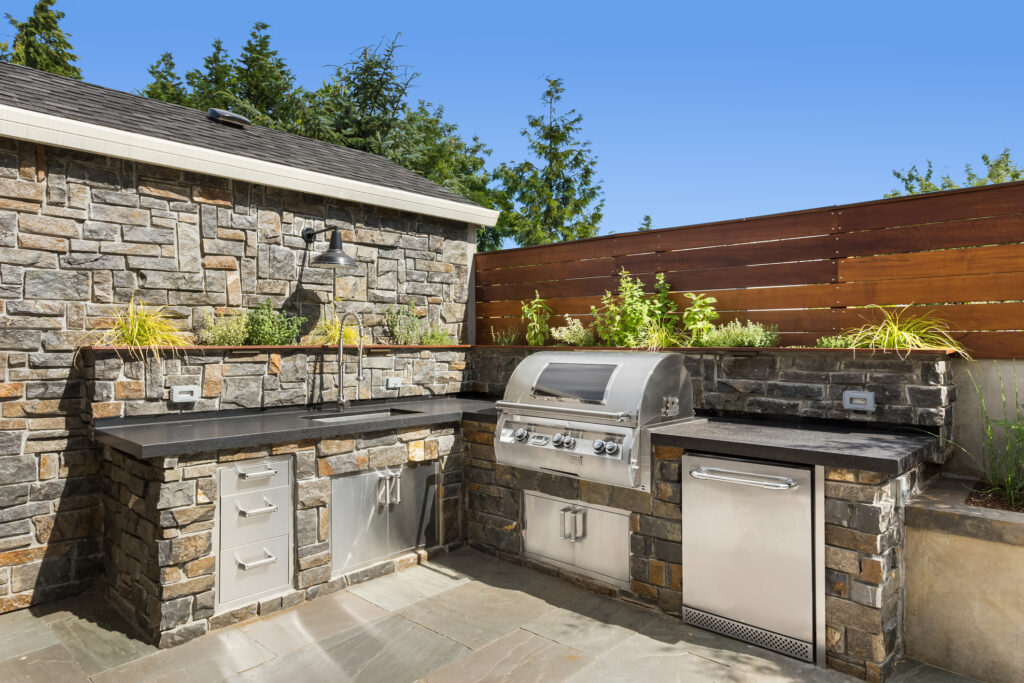
- A line for a future outdoor kitchen
- A pool or hot tub heater connection
- Indoor work such as gas stove installation in Ottawa if a kitchen upgrade is on the horizon
General gas line installation in Ottawa can cover several appliances in one properly sized project.
Winter and Ongoing Maintenance
Ottawa winters mean your BBQ likely gets stored or covered. Shut off the valve at the line, disconnect at the quick-connect fitting, and cap the outlet to keep water and debris out.
In spring, inspect the connection before reconnecting. A simple soapy-water test at the fitting will reveal a leak as bubbles. If you ever smell gas, leave the area and call the emergency line for your gas utility before doing anything else.
Frequently Asked Questions
Do I need a permit for a BBQ gas line in Ottawa?
Yes. Gas fitting work requires permits and inspection in Ontario, and the work must be done by a certified technician. A reputable contractor handles the permit application as part of the job. Skipping permits creates real problems later — with insurance claims and during home inspections when you sell.
How long does the installation take?
Most straightforward residential installations are finished in a single day. Longer runs, routes through finished space, or jobs requiring a meter upgrade take longer. The inspection may be scheduled separately depending on availability, though the line is typically ready to use once it passes.
Can I convert my propane BBQ to natural gas?
Often, but not always. It depends on whether the manufacturer offers a conversion kit for your specific model, since the burner orifices must be changed to suit the different gas pressure. Check model compatibility before planning the project, and never improvise a conversion with generic parts.
Will a gas BBQ line increase my gas bill?
It will add some usage, but grilling consumes far less gas than heating your home or water. For most households the added cost is modest, and for frequent grillers it typically comes in below what they were spending on propane cylinder exchanges over the same period.
Can the line be run under a deck or patio?
Usually yes, though it affects the approach and the cost. Lines run in those locations need appropriate protection and must remain accessible for inspection. Mention any decking, hardscaping, or landscaping plans during the site visit — it’s much easier to plan around them than to work around them afterward.
Final Takeaway
A permanent gas line for your barbecue is a modest project that removes a recurring annoyance and, for regular grillers, pays for itself over time. The keys are using a certified technician, getting proper permits, and thinking through the location before the pipe goes in.
If there’s any chance you’ll add a fire table, patio heater, or outdoor kitchen later, size for it now.
Book Your BBQ Gas Line Installation in Ottawa
Ultra Air Heating & Cooling
53 Kinetic Way, Ottawa, ON K2J 0E1
Phone: (613) 762-3035
Book Online: ultraairhvac.ca/contact-us
Done with propane tank runs? Contact Ultra Air today for a certified, permitted gas line installation and a quote based on an actual look at your property.