There’s something genuinely confusing about finding ice on your air conditioner during a heat wave. The system is supposed to be cooling your house, not building a glacier in the basement. But an AC freezing up in Ottawa homes is common, and the reason it happens says a lot about what’s gone wrong.
Freezing is always a symptom, never the root problem. Understanding what causes it tells you whether you’re looking at a filter change or a service call.
How an Air Conditioner Ends Up Covered in Ice
Your evaporator coil gets cold — that’s its job. Warm indoor air blows across it, heat transfers into the refrigerant, and the cooled air continues into your ducts. Moisture in that warm air condenses on the cold coil and drains away.
The system depends on a steady flow of warm air across the coil to keep its surface temperature above freezing. Remove that warm air, or make the coil colder than designed, and the condensation stops draining and starts freezing instead.
Once ice begins forming, it insulates the coil, which makes heat transfer worse, which makes the coil colder still. The problem accelerates — which is why a system can go from fine to fully iced over in a matter of hours.
Cause 1: A Dirty Air Filter
This is the most common cause and the easiest to fix. A clogged filter restricts the volume of air reaching the coil. Less warm air across the coil means the coil runs colder than intended, and ice forms.
During heavy summer use, filters can load up in a month. If you have pets, or if there’s construction nearby, faster still. Checking the filter should always be your first move when the system misbehaves.
Cause 2: Blocked or Closed Vents
Airflow restriction doesn’t only happen at the filter. Supply registers blocked by furniture, closed vents in unused rooms, or a return grille pushed up against a couch all reduce the air moving through the system.
Closing vents to “save energy” in unused rooms is a common instinct and generally a bad one on a ducted system — it raises static pressure and can starve the coil of airflow. Persistent low airflow problems in Ottawa homes often trace back to exactly this.
Cause 3: Low Refrigerant
When refrigerant is low, pressure in the system drops, and lower pressure means a colder coil. It’s counterintuitive — less refrigerant makes things colder, not warmer — but the physics work out that way.
The important point: refrigerant isn’t consumed. A sealed system that’s low has a leak. Adding refrigerant without finding the leak buys you a season at best, and it’s environmentally poor practice.
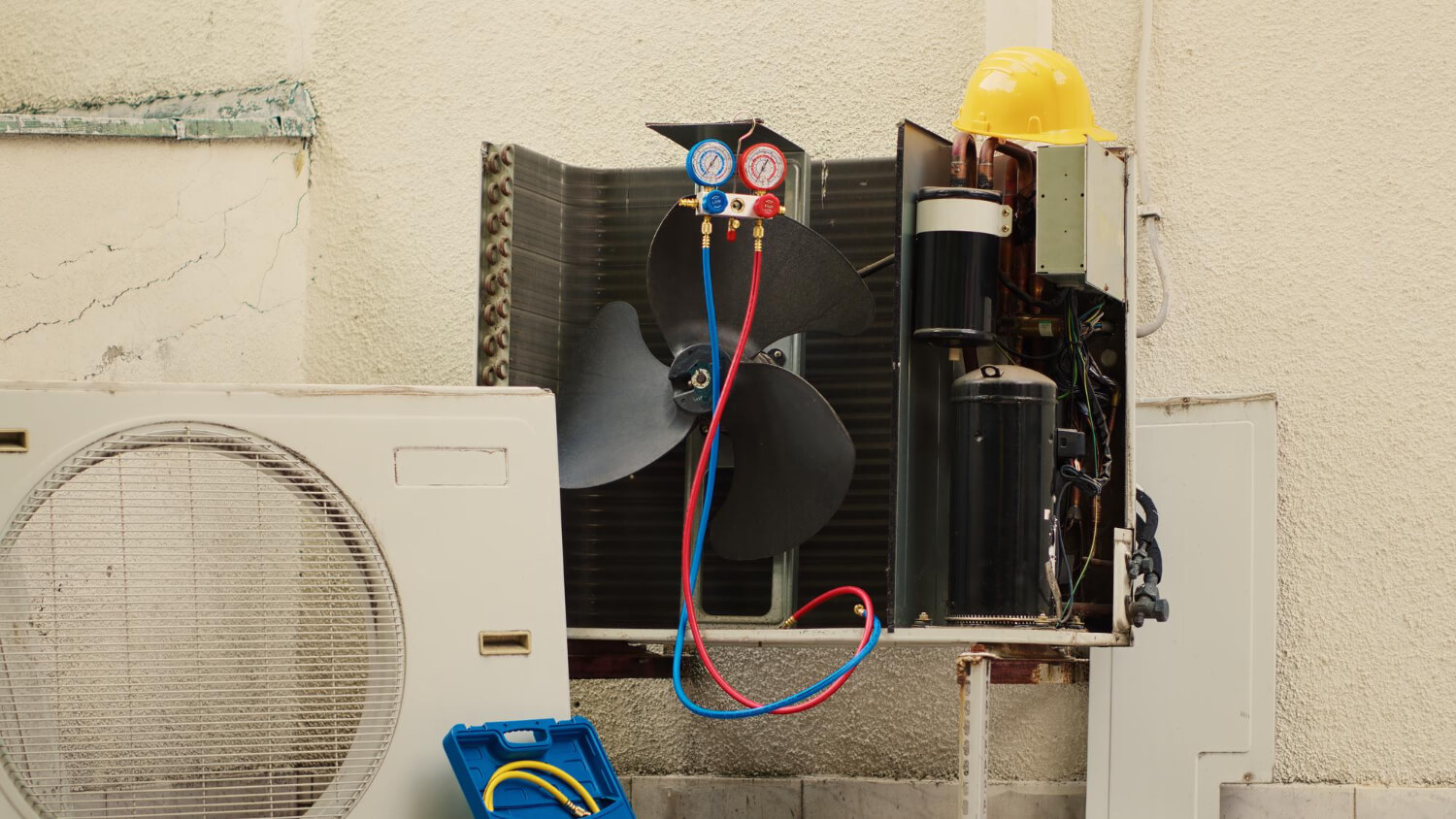
If your system freezes and the filter is clean and vents are open, refrigerant is the likely culprit. That requires certified AC repair in Ottawa — it isn’t something to attempt yourself.
Cause 4: A Failing Blower Motor
If the blower is weak, dirty, or running at the wrong speed, it can’t move enough air even with a clean filter and open vents. The result is the same as a restriction: not enough warm air across the coil.
Signs include noticeably weak airflow at every register, unusual noises from the air handler, or a blower that struggles to start. Sometimes the fix is cleaning the blower wheel — a surprising amount of dust accumulates on the blades over years.
Cause 5: Running the AC When It’s Too Cool Outside
This one catches people off guard in spring and early fall. Most residential air conditioners aren’t designed to run when outdoor temperatures drop below roughly 15°C. Below that, system pressures fall and the coil can freeze even though everything is working normally.
In Ottawa this typically shows up on a cool June evening after a hot day, when someone leaves the AC running overnight. It’s not a fault — just an operating limit worth knowing.
Cause 6: A Dirty Evaporator Coil
Over years, dust that slips past the filter builds on the coil fins. That layer of grime acts as insulation and blocks airflow between the fins, producing the same cold-coil condition as a restricted filter.
A dirty coil is a maintenance problem, and it’s the main reason annual professional cleaning matters. The coil isn’t accessible for homeowner cleaning on most systems — it needs to be opened up properly.
What to Do Right Now If Your AC Is Frozen
Work through this in order:
- Turn off cooling at the thermostat. Continuing to run it makes the ice worse and risks the compressor.
- Switch the fan to ON. Running the blower without cooling pushes warm air over the coil and speeds up thawing considerably.
- Wait. Complete thawing takes several hours — sometimes most of a day on a badly iced system. Don’t rush it.
- Never chip at the ice. The coil fins and refrigerant lines damage easily, and a puncture turns an inconvenience into a major repair.
- Manage the meltwater. Put towels down — the drain pan may not handle the volume all at once.
- Replace the filter while you’re waiting.
- Restart and watch. If it freezes again, stop and call.
Preventing It From Happening Again
Most freeze-ups are preventable with unremarkable habits: change the filter on schedule, keep vents and returns clear, don’t run cooling on cool nights, and book annual maintenance so the coil gets cleaned and the refrigerant charge gets verified.
Regular HVAC services in Ottawa catch the slow-developing causes — a gradually fouling coil, a slowly leaking charge, a blower losing efficiency — before they announce themselves as a block of ice in August.
Frequently Asked Questions
How long does it take for a frozen AC to thaw?
Anywhere from two hours to a full day, depending on how much ice built up. Running the blower with cooling off speeds this up significantly by pushing warm air over the coil. Don’t restart cooling until you’re confident every bit of ice is gone — running against remaining ice can quickly re-freeze and add strain to the compressor.
Can I use a hair dryer to speed up thawing?
It’s not recommended. Concentrated heat can damage coil fins, and you’re working with electrical components near a large volume of meltwater. The fan-only method is slower but safe and effective. If you need cooling urgently, a technician can thaw the system properly and diagnose the cause in the same visit.
Does a frozen AC mean the compressor is damaged?
Not necessarily, but running a frozen system risks it. When the coil is iced, liquid refrigerant can return to the compressor instead of vapour, which compressors aren’t built to handle. A single short freeze caught early usually causes no lasting harm. Repeatedly running an iced-up system is how compressors fail.
Why does my AC freeze up only at night?
Overnight temperatures in Ottawa can drop well below the point where a residential air conditioner operates properly, especially in early summer. If the system runs all night on a cool evening, low outdoor temperature alone can cause freezing. Setting the thermostat to a slightly higher overnight temperature usually resolves it.
Is a frozen AC an emergency?
It’s urgent but not usually an emergency. Turn the system off to prevent compressor damage and let it thaw. The real urgency depends on the underlying cause and the weather — during a heat warning, or if the household includes people vulnerable to heat, getting a technician out quickly matters a great deal more.
Final Takeaway
Ice on an air conditioner always traces back to one of two conditions: not enough warm air moving across the coil, or a coil running colder than it should. Airflow problems you can often solve yourself. Refrigerant problems you can’t.
Turn it off, run the fan, change the filter, and see whether it recurs. If it does, the cause is deeper than a filter and it’s time to bring someone in.
Fix a Freezing Air Conditioner in Ottawa
Ultra Air Heating & Cooling
53 Kinetic Way, Ottawa, ON K2J 0E1
Phone: (613) 762-3035
Book Online: ultraairhvac.ca/contact-us
Dealing with an AC that keeps icing over? Contact Ultra Air today and we’ll find the real cause — airflow, refrigerant, or blower — and get your cooling back.